
2 Fall-Themed Picture Books for Exploring Subtraction: The Pumpkin Thief and The Leaf Thief
* This post contains affiliate links. As an Amazon Associate, Mathometry earns a small commission from qualifying purchases. Know that we only link to products that we personally use and recommend.
Young children are often introduced to subraction as "taking away." However, taking away is only one kind of subtraction problem, and children who understand subtraction solely in this way may struggle when they encounter problems that involve different relationships between quantities. In 1st and 2nd grade, subtraction extends beyond simple "take away" situations. Many math standards recognize three primary subtraction problem structures - Take From/Separate, in which a quantity is reduced by removing some of its parts; Comparison (difference), in which two quantities are compared to determine how much more or fewer one has than the other; and Part-Part-Whole (Take Apart), in which a whole is composed of two parts and the relationship between them is explored. Within each structure, the unknown quantity can occupy different positions, requiring children to reason about what is known and what must be found. Providing opportunities to solve problems across all three structures and with different unknowns helps children develop flexible strategies, deepen their understanding of the relationships among quantities, and build a strong foundation for algebraic thinking.
In this post, we share two picture books by Alice Hemming and Nicola Slater that are perfect for reading during the autumn season. With their fall-themed stories, these books offer engaging opportunities to explore subtraction. In both books, Squirrel’s search for the “thief” provides a natural starting point for subtraction problems where students need to figure out how many are left, how many have gone missing, or how many there were to begin with. Look for these books in your library or click on the title links below to order from Amazon.
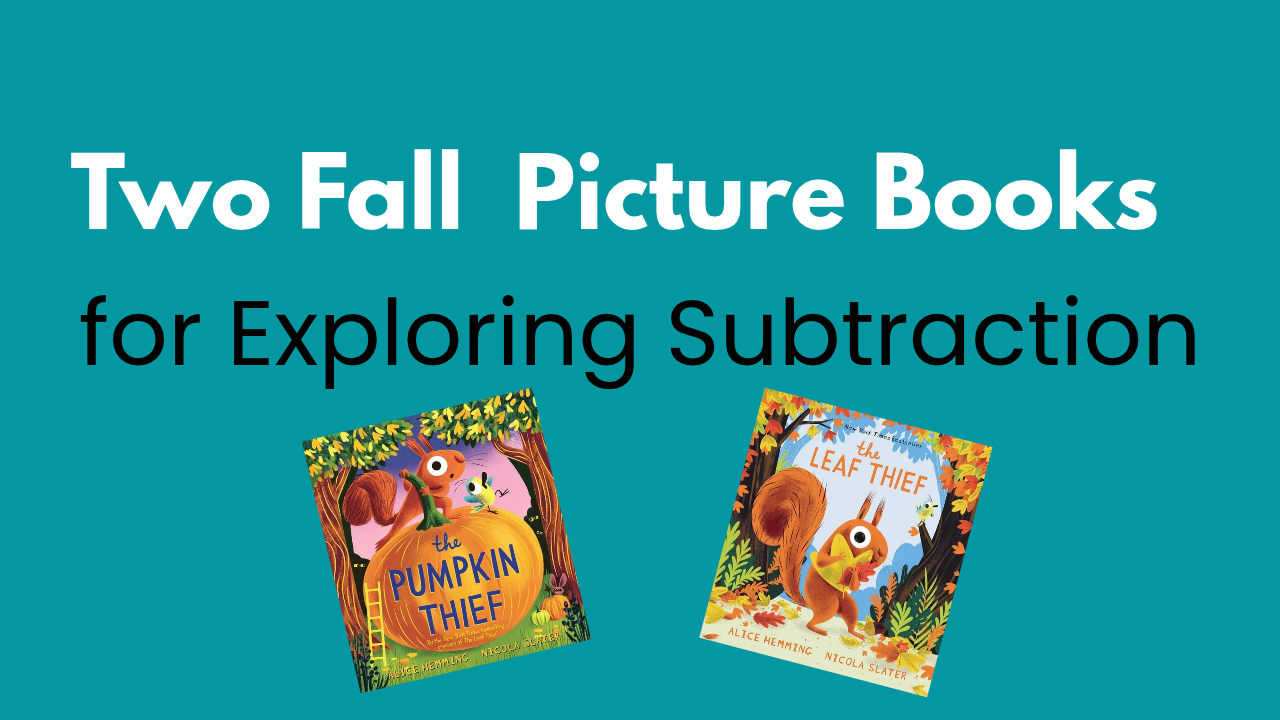
1. The Pumpkin Thief by Alice Hemming, illustrated by Nicola Slater
Bird has grown five lovely pumpkins and Squirrel has already picked his favorite: the enormous orange one. Squirrel goes off to fetch his work gloves and comes back to find only four pumpkins. Then more disappear, and Bird is nowhere to be seen. Squirrel turns detective, collecting clues like peck marks and footprints. The truth is that Bird has been delivering pumpkins to their friends and saving the largest one for Squirrel.
Questions to Ask
- Bird grew 5 pumpkins. When Squirrel came back, there were 4. How many went missing? How did you figure it out?
- Bird grew 5 pumpkins. Squirrel said the pumpkin thief took 3 pumpkins and there are 3 left. Could that be right? Convince Squirrel.
- Bird gave a pumpkin to each friend and saved one for Squirrel. If Bird started with 5 pumpkins, how many friends got a pumpkin?
Try This
- Pumpkin Patch Detectives: Start with 5 to 10 pumpkins (orange snap cubes) in a patch (on a green sheet of paper or a paper plate). Have students work with a partner. Partner A closes his/her eyes while Partner B removes some pumpkins and hides them from view. Partner A opens his/her eyes, counts how many pumpkins are left, works out how many pumpkins were removed and explains his/her thinking.
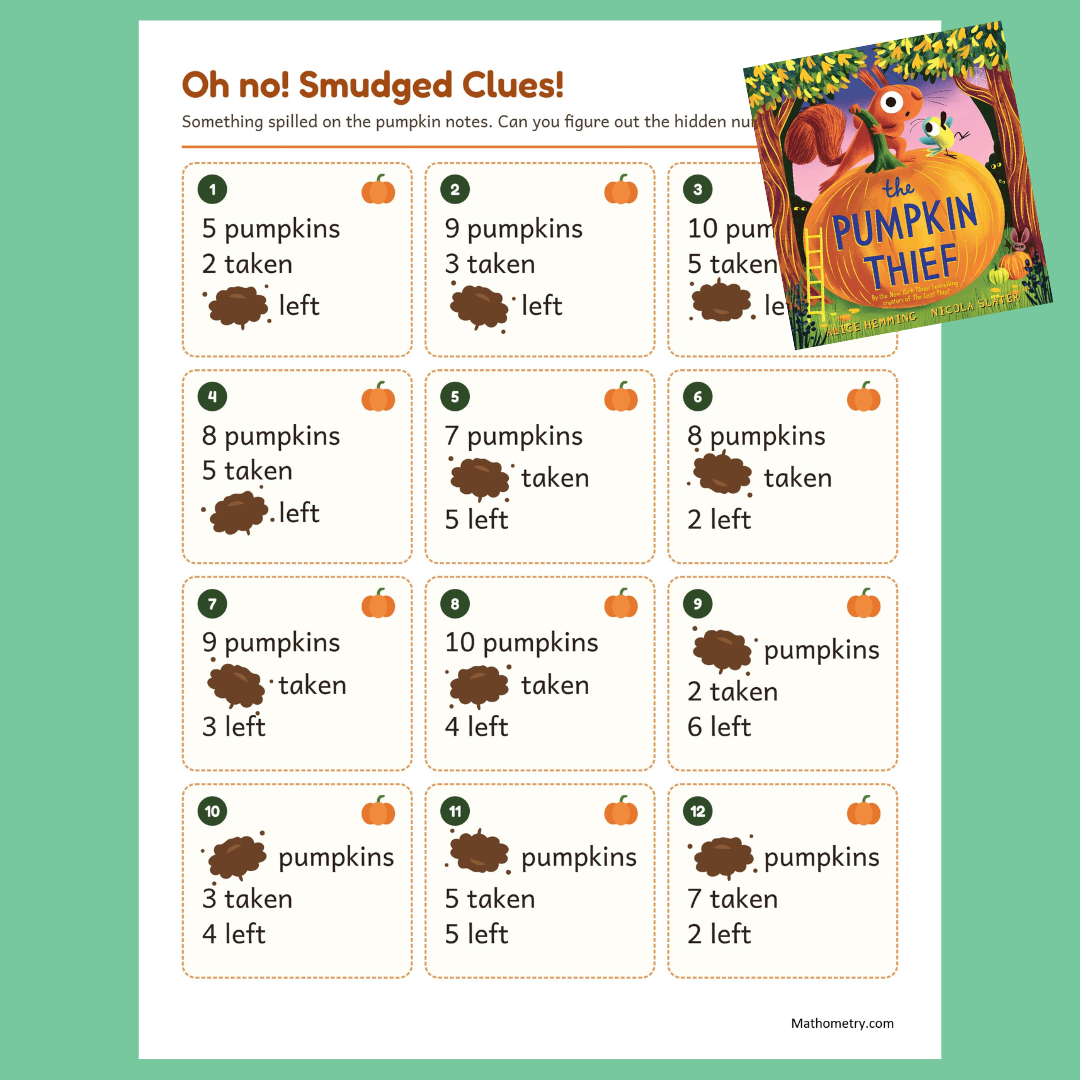
- Smudged Pumpkin Cards: Use pumpkin thief stories with one number covered by a pumpkin image such as 8 pumpkins, ? taken, 4 left (or ? pumpkins, 3 taken, 6 left). Children determine the missing number and explain their strategy. The unknown start is the most difficult - listen for children who think addition for subtraction (I know 3 + 3 equals 6, so 6 minus 3 equals 3).
- Thinking Task: Pose this to groups of 2 at vertical whiteboards. "Bird grew some pumpkins. He gave some away. Now there are 5 left. How many pumpkins might Bird have grown? How many might he have given away? Find as many different solutions as you can." This question has a low floor and high ceiling. Some partnerships will draw a few examples, and others will make a systematic list or notice a pattern. Use their boards to talk about how the start, the change, and the result are connected.
2. The Leaf Thief by Alice Hemming, illustrated by Nicola Slater
Squirrel loves his tree and every one of its beautiful red, gold, and orange leaves. So when he notices a leaf is missing, he is certain someone stole it. As more leaves vanish, squirrel suspects Mouse, then Woodpecker, and even his friend Bird. In the end, Bird shows Squirrel that the real thief is the wind and explains that this happens every autumn.
Questions to Ask
- Squirrel's tree had 20 leaves. Now it has 9. How many did the thief take? How do you know?
- If 3 more leaves fall, how many will be left on the tree? How many will be on the ground?
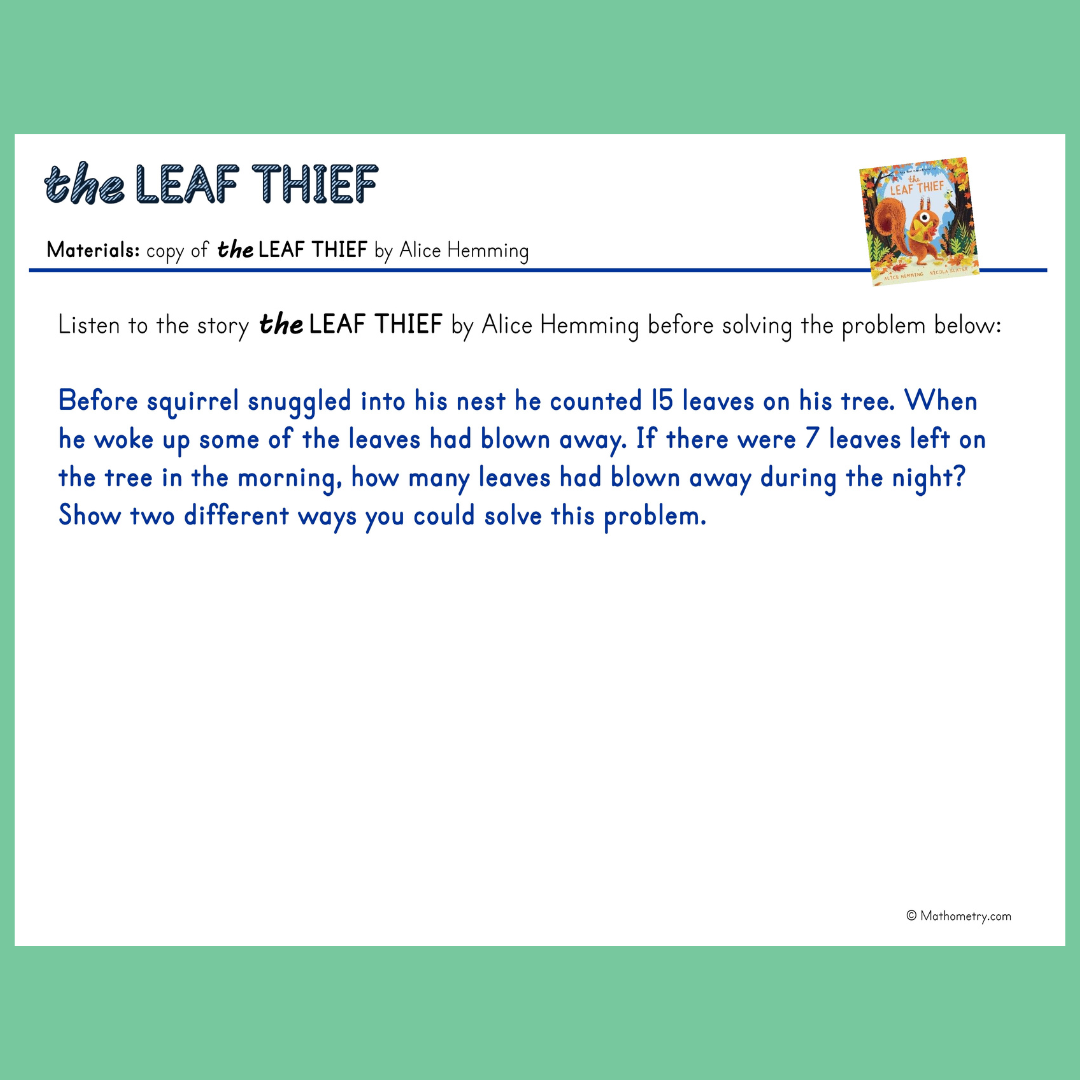
- Before Squirrel snuggled into his nest he counted 15 leaves on his tree. When he woke up some of the leaves had blown away. If there were 7 leaves left on the tree in the morning, how many leaves had blown away during the night?
- Before Squirrel snuggled into his nest he counted the leaves on his tree. When he woke up he noticed that 9 leaves had blown away. If there were 5 leaves left on the tree in the morning, how many leaves were on the tree when Squirrel counted them?
Try This
- Provide an image of a simple tree with a line for the ground. Children arrange 10 leaves (fall colored counters) with some on the tree branches and some on the ground. Ask them to find as many ways as they can to arrange the leaves, and to record each as a subtraction equation (10 - 3 = 7) and its matching addition equation (7 + 3 = 10). Ask, "How will you know when you've found all the ways?"
- Smudged Leaf Cards: Use leaf thief stories with one number covered by a leaf image such as 9 leaves, ? fell, 5 left (or ? leaves, 2 fell, 6 left). Children determine the missing number and explain their strategy. The unknown start is the most difficult - listen for children who use addition to solve subtraction (I know 4 + 2 equals 6, so 6 minus 2 equals 4).
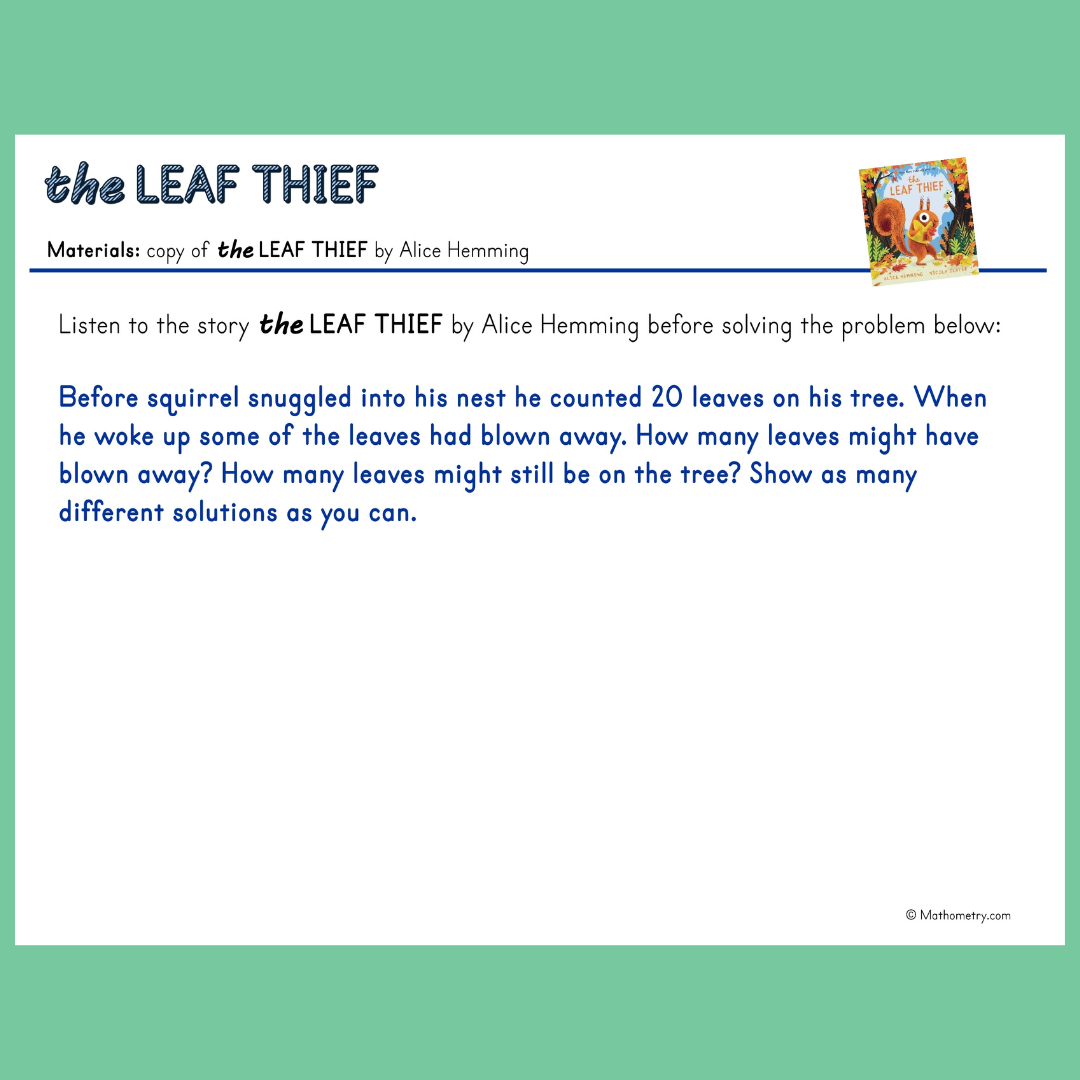
- Thinking Task: Pose this to groups of 2 at vertical whiteboards. "Before Squirrel snuggled into his nest he counted 20 leaves on his tree. When he woke up some of the leaves had blown away. How many leaves might have blown away? How many leaves might be still on the tree? Show as many different solutions as you can."
Tips for Getting the Most Out of Your Read-Alouds
- Read it twice: Enjoy the story on the first day. On the second day, stop at the parts where something goes missing and ask math questions.
- Keep manipulatives nearby: Ten frames, snap cubes, counters and rekenreks let children model what is happening to the leaves and pumpkins as the story unfolds.
- Vary the Unknown: Don't stop at "how many are left?" Ask children to find how many were taken and how many were there to begin with. Those problems build real understanding of subtraction.
- Connect subtraction to addition: When a child says, "I know 6 plus 2 makes 8, so 8 minus 2 equals 6" record the addition and subtraction equations side by side. Thinking addition is one of the most useful subtraction strategies children can learn.
Subtraction is more than taking away. With a worried Squirrel, a patient Bird and a few fall manipulatives, children can explore what's missing, what's left, and what was there at the start, and they'll have fun doing it.
Looking for more math read-alouds for K-2? Check out this post: Five Picture Books for Exploring Facts of Ten