
Why the Alligator Trick Fails — and What to Teach Instead
It's a commonly used trick in elementary math, seen on anchor charts in many classrooms. And it's worth retiring.
The alligator gives students a way to place a symbol without ever forming a mathematical statement. Worse, it hands them a trick that expires the moment numbers get more interesting—and by the time it no longer works, the students who learned it are three or four years down the road and no longer in your classroom.
Here's the case against it, and what to do instead.
The problem: the alligator never defines bigger
"The alligator eats the bigger number" tells students which way to point the symbol. It tells them nothing about what bigger means, so students supply their own definition—and the one they reach for, most often, is more digits.
That definition is 100% reliable for whole numbers. Every whole number with more digits is greater. This is why the trick survives kindergarten through second grade completely undetected. It produces correct answers on every task we give students at that age.
Then the numbers change, and it no longer works.
Decimals
Students write 1.234 > 7.8, because 1.234 has more digits.
This is one of the most persistent errors in upper elementary. It isn't carelessness—it's a student faithfully applying the trick we gave them to a number system where it no longer holds.
Fractions
Students write 1/10 > 1/2, because 10 is bigger than 2.
Again, the student is doing exactly what they were trained to do: look at the numerals, decide which looks bigger, point the mouth.
Negative numbers
Students write −72 > −4, because 72 is bigger than 4.
The alligator has no way to handle direction. It only knows size, and with negatives, size and value point opposite ways.
In all three cases, the rule was never about quantity. It was about which numeral looked hungrier. And in the meantime, a fair amount of instructional time has gone into drawing teeth and eyes on a symbol instead of building the concept underneath it.
The damage carries into middle school
This is the part most elementary teachers never get to see, because it surfaces years later.
When students see an inequality like y > 5x + 4 and are asked to graph it, the alligator has nothing to offer. There is no number for it to eat.
Students who learned that > means "the big side points at the bigger one" have no way to read that statement as "y is greater than 5x + 4"—a sentence about a relationship between two varying quantities, and ultimately about which side of a line the solutions live on. They're stuck trying to apply a picture to something that isn't a picture anymore.
The symbol was always a word. If students never learned it as a word, Algebra 1 is where it falls apart.
What to teach instead
1. Treat > and < as the words they are
They aren't alligator mouths. They're mathematical symbols that denote a relationship between two values that should be stated, not drawn.
38 < 43 isn't a picture of two numbers. It's a sentence: "38 is less than 43." A sentence you can read aloud, agree with, or argue about. A picture is just a picture.
Every comparison a student writes should be readable aloud as a complete sentence:
- 38 < 43 → "38 is less than 43."
- 0.7 > 0.45 → "7 tenths is greater than 45 hundredths."
The test: if a student can write the symbol but can't read the comparison statement out loud, the symbol is decoration. Reading it aloud builds a habit that still works in Algebra 1.
2. Connect the symbols to a horizontal number line
This is the replacement image, and it's a far better one than the alligator because it's mathematically true.
Look at a horizontal number line. The symbols are already there, embedded at each end:
- The arrow on the left end is a <. It points in the direction the numbers get smaller.
- The arrow on the right end is a >. It points in the direction the numbers get larger.
The symbol isn't a mouth. It's an arrow, and it's pointing the same way the number line points.
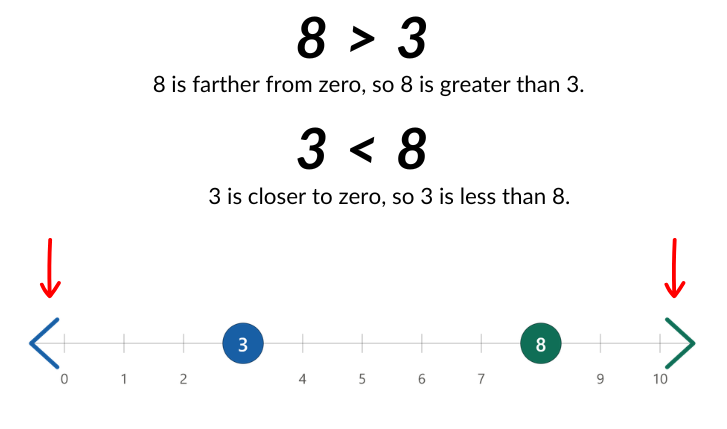
This does something the alligator can never do: it keeps working. Put fractions on a number line, and 1/10 sits left of 1/2. Put decimals on it, and 1.234 sits well to the left of 7.8. Put negative numbers on it, and −72 sits far to the left of −4, so −72 is less than −4 is visible rather than counterintuitive. Every one of the three broken examples above resolves itself the moment students have a number line to reason with.
Draw the connection explicitly and often. When students write a comparison, ask "Show me where those two numbers go on the number line. Which one is further right?"
3. Ask for justification, not just the symbol
The symbol records a decision. It isn't the decision. A comparison isn't finished until a student can explain why:
"I know 4,271 is greater than 4,198 because they both have 4 thousands, but 271 has 2 hundreds and 198 has only 1 hundred."
Sentence frames make this routine rather than occasional:
- "I know ____ is less than ____ because…"
- "I know ____ is greater than ____ because…"
Model and expect precise language. Use "greater" rather than "bigger," and "less" rather than "smaller."
But my students already learned the alligator
You don't need to stage a dramatic unteaching. You just need to make the alligator unnecessary.
- Stop accepting it as a justification. When a student says "the alligator eats the bigger number," respond with "Read the comparison statement for me."
- Change what you ask for. If your prompt is "fill in <, >, or =," students only have to point a symbol. If your prompt is "write a comparison statement and read it aloud to your partner," they have to produce language.
- Watch for the tell. A student who is drawing teeth on the symbol is thinking about the picture, not the numbers. It's a useful, visible signal about where their attention is.
The takeaway
Using the alligator pits short-term correctness against long-term understanding. It isn't worth it, because when the mathematics gets more challenging—fractions, decimals, negative numbers, and inequalities—students have no idea why it no longer works.
The alternative isn't harder to teach. It's a sentence and a number line (alongside lots of concrete practice building and comparing numbers).
This post expands on Comparing and Ordering Numbers in K–5: The Progression and 4 Games, which shares four games for building fluency in comparing and ordering numbers.