
Comparing and Ordering Numbers in K–5: The Progression and 4 Games
Ask a group of teachers to name the most important skills in the elementary math curriculum and you'll hear addition facts, multiplication facts, maybe fractions. Comparing and ordering numbers rarely makes the list. It feels like a warm-up skill — something students "get" in a lesson or two and move past.
But comparing and ordering numerals is not a side task. It is a window into whether a student actually understands place value, and it quietly underpins many things that come later: rounding, estimating, reasonableness checks, computation strategies, fractions, decimals, measurement, and data. When students can order numbers fluently and explain why one number is greater than another, they are reasoning about quantity. When they can only follow a memorized rule, they are reading digits.
Here's why this skill deserves real instructional time from Kindergarten through 5th grade — and four games we use to build it.
Comparing is a place value skill
The NYS standards make the progression explicit. Comparing numbers is not introduced once and retired. It is revisited each year, each time with a larger place value structure underneath it.
Kindergarten — K.CC.C.7 Compare two numbers between 1 and 10 presented as written numerals.
Notice the phrase "presented as written numerals." Students have already been comparing groups of objects and matching sets one-to-one. This standard asks them to make that judgment from the symbol alone — to look at 7 and 4 and know, without counting anything, which represents more. That's a significant abstraction: the numeral has to carry meaning about quantity on its own.
Grade 1 — 1.NBT.B.3 Compare two two-digit numbers based on meanings of the tens and ones digits, recording the results of comparisons with the symbols >, =, and <.
The critical language is "based on meanings of the tens and ones digits." First graders aren't meant to compare 43 and 38 by counting up or by looking at which numeral "looks bigger." They're meant to reason: 43 has 4 tens, 38 has 3 tens, so 43 is greater. This is where comparison becomes a place value task, and where the symbols enter as a way to record reasoning that already happened.
Grade 2 — 2.NBT.A.4 Compare two three-digit numbers based on meanings of the hundreds, tens, and ones digits, using >, =, and < symbols to record the results of comparisons.
Same reasoning, extended by one place. Second graders now have to know that hundreds carry more weight than tens, and that they need to keep comparing only when the values in a place are equal — 348 versus 352 requires moving to the tens because the hundreds match.
Grade 4 — 4.NBT.A.2 Compare two multi-digit numbers based on meanings of the digits in each place, using >, =, and < symbols to record the results of comparisons.
By fourth grade the structure has to generalize. Students work with numbers into the hundred thousands and millions, and the standard no longer names specific places — it says "the digits in each place." That's the point. If a student has genuinely built the reasoning in K–3, comparing 407,318 and 407,381 is the same intellectual move as comparing 43 and 38.
Third grade doesn't have a standalone comparison standard, but comparison is crucial for 3.NBT.A.1 (round to the nearest 10 and 100) — you cannot round without deciding which benchmark a number is closer to. And in fifth grade, 5.NBT.A.3b asks students to compare decimals to thousandths using the same symbols and the same place value logic.
Six grade levels, one idea, deepening each year.
What comparing and ordering actually builds
1. It exposes place value understanding — or the absence of it
A student can chant "hundreds, tens, ones" and still not understand that a digit's position determines its value. Comparison forces the issue. Ask a student to compare 19 and 91 and their reasoning tells you immediately whether they see two different quantities or two arrangements of the same digits.
2. It is the engine of rounding and estimation
Rounding is a comparison task. "Round 472 to the nearest hundred" means "is 472 closer to 400 or 500?" Students who struggle with rounding in Grades 3–5 very often have an unresolved comparison and ordering issue underneath. Teaching a rounding rhyme doesn't help; rebuilding number sense does.
3. It powers reasonableness checks
We want students to notice when an answer can't possibly be right. That habit depends entirely on being able to place a number relative to others. A student who computes 38 + 47 and gets 715 has no internal alarm unless they can order 715 against a mental estimate of "somewhere in the eighties."
4. It sets up fractions and decimals — and the misconceptions that come with them
A persistent error in upper elementary is whole number bias: believing 0.45 > 0.7 because 45 > 7, or that 1/8 > 1/5 because 8 > 5. Students who have compared based on meanings of the digits rather than by digit-counting rules are far better positioned to recognize that a new number system needs a new comparison strategy. Students who learned "more digits means bigger" carry that rule straight into decimals, where it fails.
Four of our favorite games for building this fluency
All four are two-player, require only a pack of 0–9 numeral cards, and generate more reasoning per minute than a page of practice problems.
They split into two types, and it's worth using games from both:
- Ordering games — Climb the Stairs and Plot the Numbers ask students to place numbers into a sequence, so every move requires checking in two directions at once.
- Comparing games — Place Value Challenge and Place Value Triangle put two numbers head to head and demand a justification.
Ordering is the less-practiced of the two, and it's the one that builds a mental number line. Comparing is where the symbols and the language get rehearsed. Students need both.
1. Climb the Stairs
Materials: set of numeral cards (0–9) | Players: 2
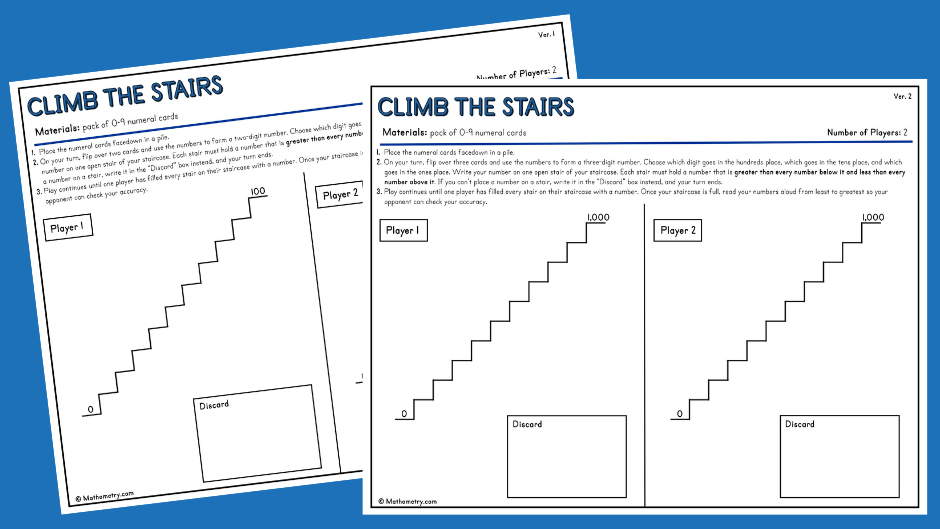
Each player has a staircase with 0 at the bottom step and 100 at the top (Version 1) or 1,000 at the top (Version 2). Cards go facedown in a pile.
On your turn, flip two cards (Version 1) and decide which digit goes in the tens place and which goes in the ones place. Write your number on any open stair. The rule that makes the game: every number must be greater than every number below it and less than every number above it. If you can't place your number, it goes in the Discard box and your turn ends. Play continues until one player fills every stair. That player reads their numbers aloud from least to greatest so their opponent can check the accuracy.
Version 2 works the same way with three cards, a three-digit number, and a staircase running from 0 to 1,000.
Why it works: The staircase makes ordering visible and permanent. Students aren't comparing two numbers in isolation — they're placing a number into an ordered sequence, which means every placement requires them to check upward and downward. It's an ordering task, a comparison task, and a strategy task simultaneously.
The genuinely rich decision is which digit to put in the tens place. Flip a 7 and a 2 and you can make 72 or 27, two very different placements with very different consequences for the rest of your staircase. Students start out using the biggest number they can make and gradually discover that spreading numbers across the full range beats crowding them at the top. That shift is real strategic reasoning about the number line.
Teacher moves:
- After a turn, ask "Why did you put it on that stair and not the one below?"
- When a student discards, ask "What number would have worked there?"
- Ask "Which stair is riskiest to fill early? Why?"
- Have students record the final staircase and write two comparison statements using > and <
Differentiating: Version 1 fits Grade 1 and early Grade 2. Version 2 fits Grade 2 into Grade 3 and works well as review for older students who are shaky on three-digit place value.
2. Plot the Numbers
Materials: set of numeral cards (0–9) | Players: 2
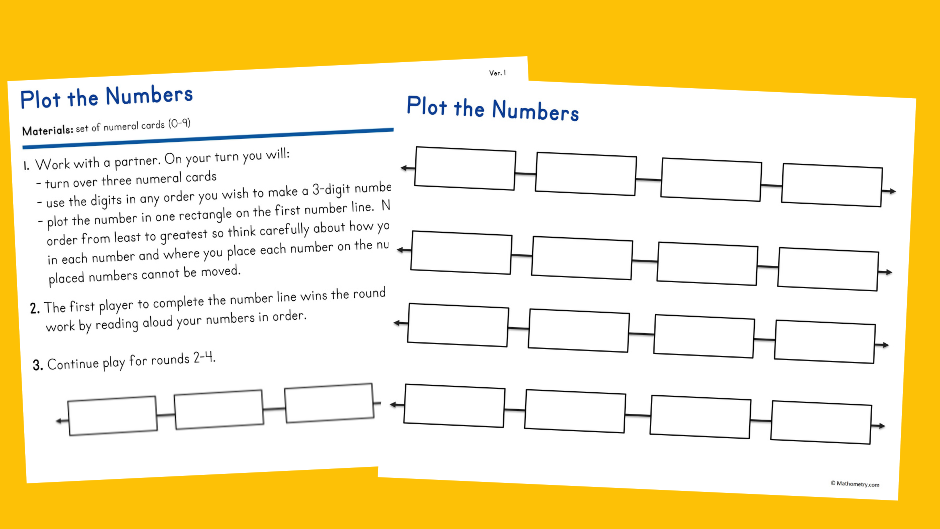
This is where Climb the Stairs goes next. Partners work side by side, each with a recording sheet of number lines divided into rectangles.
On your turn, flip four numeral cards, arrange the digits in any order to make a four-digit number, and plot that number in one rectangle on the first number line. The numbers on a line must end up in order from least to greatest — and once a number is placed, it cannot be moved. The first player to complete a number line wins the round, and partners check each other's work by reading their numbers aloud in order. Play continues for rounds 2 through 4.
Versions run from three-digit numbers up to six-digit numbers, so the same game structure carries a class from Grade 2 all the way through Grade 5.
Why it works: The number line has no endpoints. Climb the Stairs gives students anchors, 0 at the bottom, 1,000 at the top, and those anchors do a lot of quiet scaffolding. Plot the Numbers takes them away. The arrows point off in both directions, so students have to reason about relative position: is this number greater than the one to its left and less than the one to its right? That's a genuine step up in abstraction and a direct rehearsal for every number line they'll meet later, including the ones with fractions and negative numbers on them.
The "cannot be moved" rule is what makes it a thinking game rather than a sorting activity. Because students choose both the digit arrangement and the rectangle, every turn is a decision under uncertainty: flip a 4, 0, 8, and 3 and you can make anything from 3,048 to 8,430. Placing 8,430 in the leftmost rectangle isn't illegal — it just means the next three numbers all have to be greater than 8,430. Students learn this the hard way once and then never again.
Teacher moves:
- Ask "What's the biggest number you could make with those digits? The smallest? Which one helps you more right now?"
- After a placement, ask "What range of numbers can still go in the rectangle to the right?" This is the question that turns the game into number line reasoning.
- When a line goes wrong — ask "Which placement caused the problem?" It's rarely the last one.
- Ask "Would you rather go first or second? Why?"
Differentiating: Use the three-digit version in Grade 2, four-digit in Grades 3–4, and five- or six-digit in Grades 4–5. Students who require more scaffolding can play with the digits pre-arranged (flip the cards and read the number left to right as dealt) so the only decision is placement.
3. Place Value Challenge
Materials: Place Value Challenge mat and recording sheet, numeral cards 0–9 (4 of each) | Players: 2
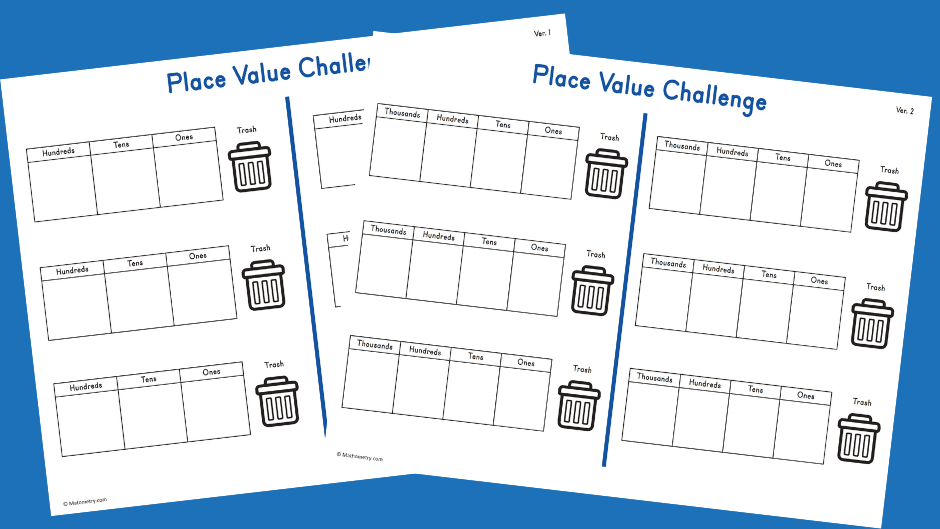
Deal four cards to each player. Using those four cards, each player builds the largest three-digit number they can, which means one card has to be thrown away, into the "Trash" can on the mat. Players record both their number and their discard, then compare. The largest number that round scores a point. Six rounds; most points wins.
Version 2 deals five cards and builds the largest four-digit number, with a thousands column added to the mat.
Why it works: The trash is the whole design. Most place value games ask students to arrange digits; this one asks them to decide which digit is worth discarding. That's a much sharper question. A student who discards the 9 instead of the 1 doesn't have a slip-up — they have a genuine misunderstanding about what position does to value, and it shows up immediately and visibly on the mat.
The recording sheet also gives you a record of exactly that decision across six rounds, which makes this a useful formative assessment game. You can look at a completed sheet and know within seconds whether a student is reasoning about place value or shuffling digits.
The sentence frames matter here too:
- "My number is ___. ___ is greater than ___."
- "My number is ___. ___ is less than ___."
Note that the frames come in both directions. The winner says the "greater than" sentence and the other player says the "less than" sentence, so every round rehearses both statements about the same pair of numbers. That's exactly the habit that makes talk about "alligators eating the bigger number" unnecessary — students are producing full comparison sentences out loud, both ways, every single round.
Teacher moves:
- Ask "Why did you trash that card?"
- "Was there a better number you could have made? Show me."
- When a player is dealt four low cards, ask "Can you still win this round? What would have to happen?"
- Look across the recording sheet at the end: "Look at all six of your discards. What do you notice?"
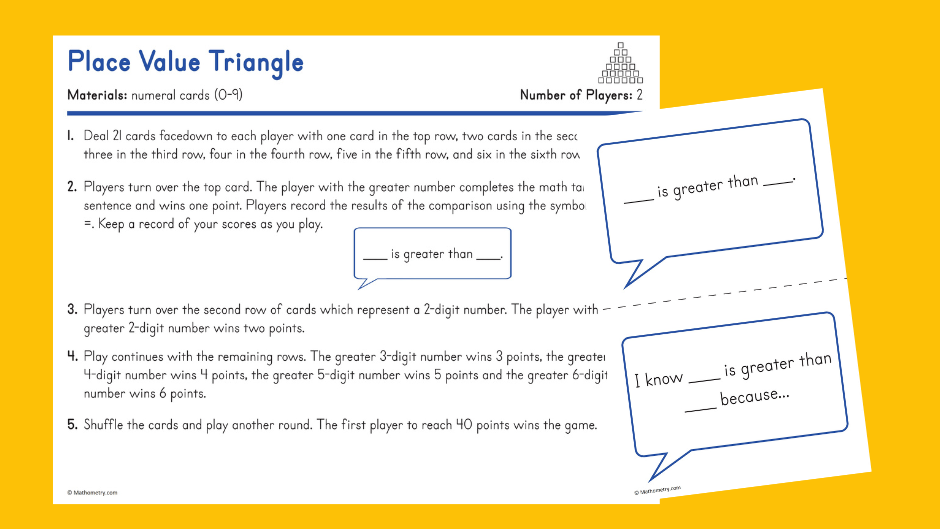
4. Place Value Triangle
Materials: pack of 0–9 numeral cards | Players: 2
Each player deals themselves 21 cards facedown in a triangle: one card in the top row, two in the second row, three in the third, four in the fourth, five in the fifth, and six in the sixth.
Players flip their top card. The greater number wins one point, and the winner completes the math talk sentence. Both players record the comparison with <, >, or =. Then players turn over the second row with two cards forming a two-digit number and the greater number wins two points. Play continues down the triangle: greater three-digit number wins 3 points, four-digit wins 4, five-digit wins 5, six-digit wins 6. Shuffle and play again. First player to 40 points wins.
Why it works: The increasing rows mean every single round is a place value lesson at a new magnitude, and students experience the same reasoning applied to bigger and bigger numbers within a few minutes. That's exactly the generalization 4.NBT.A.2 is asking for.
Because the cards are dealt facedown and flipped in position, students can't arrange their digits — they have to read and value the number they were given. This is a useful contrast to Climb the Stairs, where students choose placement. One game builds strategic thinking about place value; the other builds fluent reading and valuing of multi-digit numerals.
The scoring is deliberate too: bigger numbers are worth more points, so students stay invested through the six-digit rows, which are usually the ones they need most practice with.
The sentence frame is the whole point:
- "I know ____ is greater than ____ because..."
Insist that students use the sentence frame. "I know 4,271 is greater than 4,198 because they both have 4 thousands, but 271 has 2 hundreds and 198 has 1 hundred" is the reasoning 4.NBT.A.2 describes. Without the frame, students tend to point and say "that one."
Teacher moves:
- When a row is close, ask both players to justify before revealing who won.
- Ask "Which place decided it?" — this builds the habit of comparing from the greatest place and moving right only when values are equal.
Differentiating: For an extra challenge with fifth graders, insert a decimal point in a fixed position and play the same game with 5.NBT.A.3b in mind.
The takeaway
Comparing and ordering numerals looks like a small skill. It isn't small. It's the observable evidence that a student understands what a digit's position means — and that understanding is crucial for rounding, estimation, computation, fractions, and decimals all the way through elementary school and beyond.
Give it real time. Give students something to discuss. And listen for "because."
Resources
Climb the Stairs, Plot the Numbers, Place Value Challenge, and Place Value Triangle, including multiple versions of each game, are available in the All Access Math Hub, along with 2,000+ other print-and-play games and hands-on activities for K–5 math.
Not yet a member? Click the button below to visit our SAMPLE RESOURCES page.