
Using Hands-On Activities for Volume in 5th Grade
Volume is often introduced in 5th grade as a formula - length × width × height - and practiced with worksheet problems where students plug in numbers. But students build real understanding of volume through hands on experiences: physically building, filling, and comparing three-dimensional space. Students who only memorize the formula can compute an answer without picturing what it means, and that gap shows up as soon as a problem looks unfamiliar.
Why Volume Understanding Matters
Volume is one of the more abstract measurement concepts in elementary math. Unlike length or area, volume asks students to reason about three dimensions at once. That is hard to do in the abstract, especially for students who haven't had much concrete experience with three-dimensional shapes.
Students who understand volume conceptually can:
- explain what a cubic unit represents, not just calculate with one
- see why length × width × height works, instead of applying it as a memorized rule
- estimate whether an answer is reasonable
- reason through unfamiliar or multi-step problems, including composite figures
- connect volume to real-world contexts
Without this foundation, students may apply the formula correctly on an assessment and still be unable to answer a simple question like, "About how many centimeter cubes would fit in this box?"
Why Worksheets Fall Short
Worksheet practice on volume usually looks like this:
- Find the volume of a rectangular prism with dimensions 4 cm × 3 cm × 5 cm
- A box is 6 in long, 2 in wide, and 3 in tall. What is its volume?
Students can plug these numbers into the formula and get a correct answer without knowing what a cubic centimeter or cubic inch looks like, or why multiplying three dimensions together gives a measure of space rather than length.
Without that mental image, students also don't catch their own errors. A student who understands volume would immeniately see that 4 cubic centimeters is far too small for a shoebox. A student relying only on the formula has no way to catch that mistake.
The Value of Hands-On Volume Experiences
When students build rectangular prisms from unit cubes, pack boxes, and count layers, they start to see volume instead of just calculating it. This is when the formula stops being a rule to memorize and becomes a shortcut for something they already understand.
Classroom experiences can include:
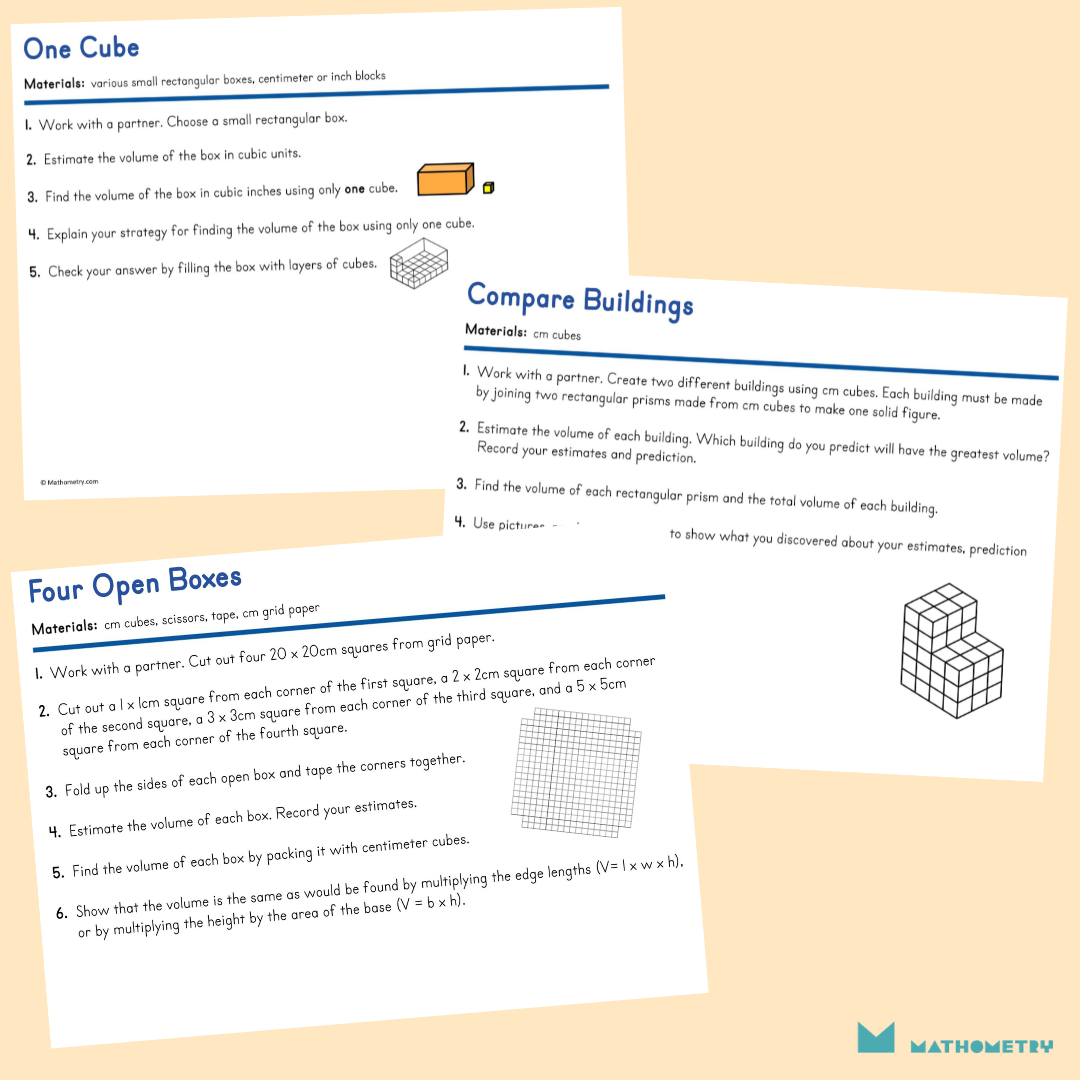
- building rectangular prisms with connecting cubes and counting the total number of unit cubes used
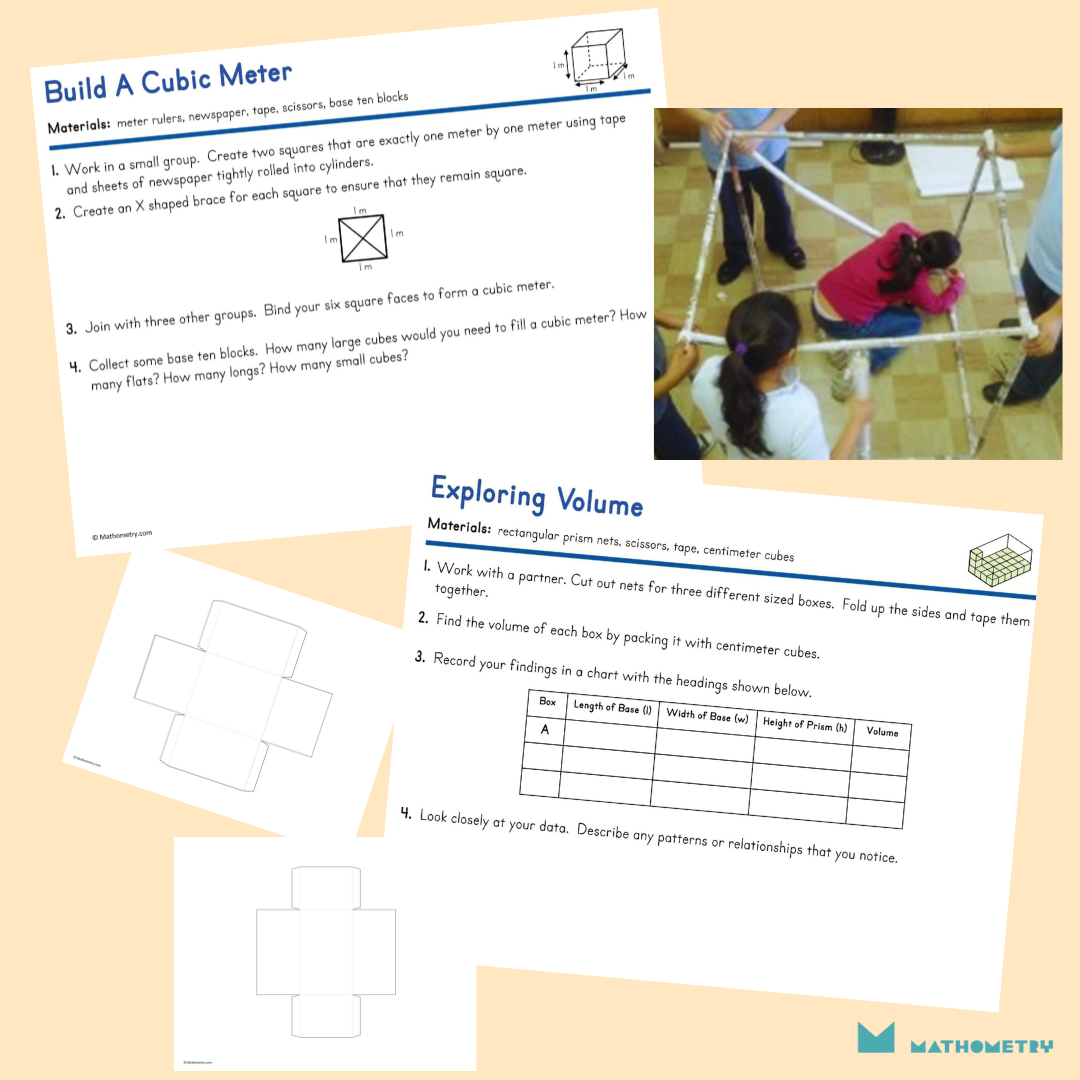
- packing a small box with centimeter cubes to find its volume, then checking the answer with the formula
- covering the base of a prism with one layer of cubes, then multiplying by the number of layers to see why the formula works
- building a cubic meter from rolled newspaper in small groups to get a sense of the size, then estimating how many small units would fit inside
- comparing two prisms with different dimensions but the same volume, to build the idea that volume measures space, not shape
- estimating the volume of everyday classroom objects, then measuring to check
These experiences give students a mental benchmark for a cubic unit, so the formula makes sense instead of feeling like one more fact to memorize.
Building Real Understanding
The goal of teaching volume in 5th grade isn't just a correct number. it's for students to understand what that number represents. Hands-on exploration, discussion, and meaningful problem-solving build this understanding far more effectively than worksheets alone.
If we want students to truly understand volume, they need many opportunities to build, pack, and compare three-dimensional space both before, during, and after they learn the formula.
Resources
Head to the 5th Grade Measurement & Data section of the All Access Math Hub for hands-on volume tasks and centers. You'll also find volume projects in the Grades 3-5 Math Projects section.
Not yet a member? Click the button below to download SAMPLE RESOURCES from the Hub.