
How Many Squares? A First-Week Task That Sets Math Norms
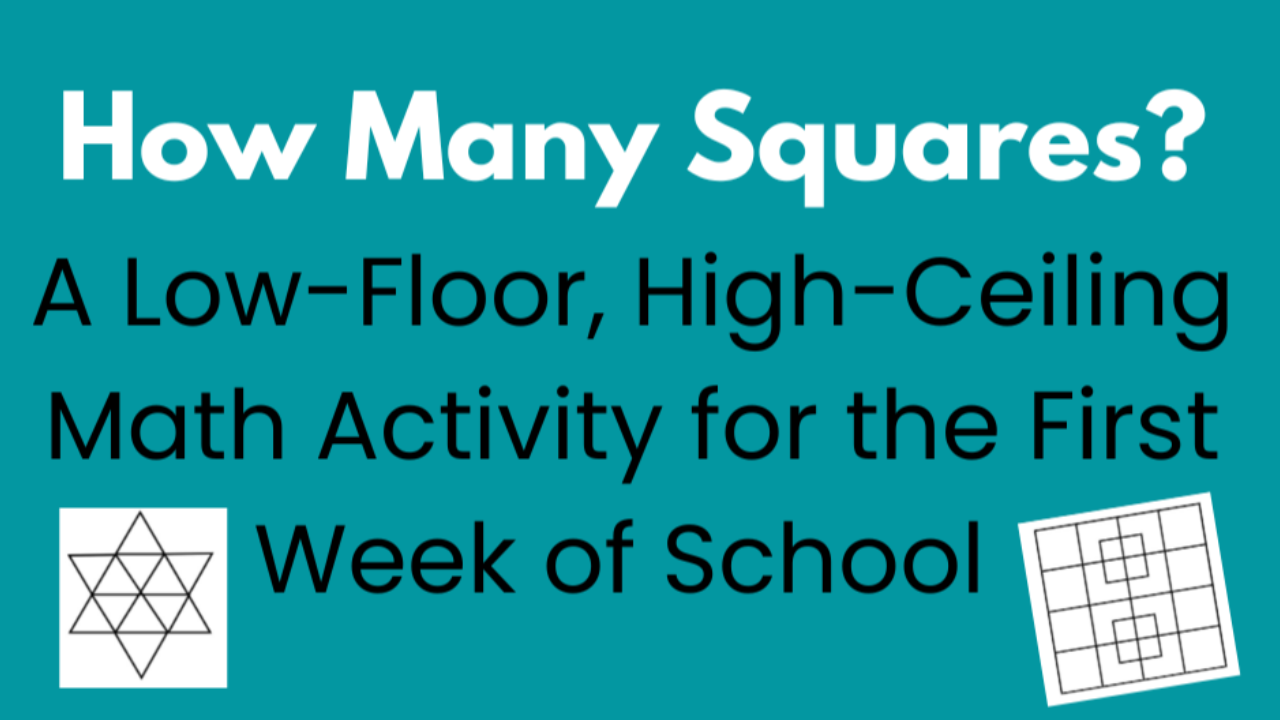
If you've spent time on social media, you've probably seen the image: a grid of squares with the caption "99% of people get this wrong — how many squares can you find?" It looks like clickbait. It's actually a great low-floor, high-ceiling task to present to your class in the first week of school.
What's Actually Going on Mathematically?
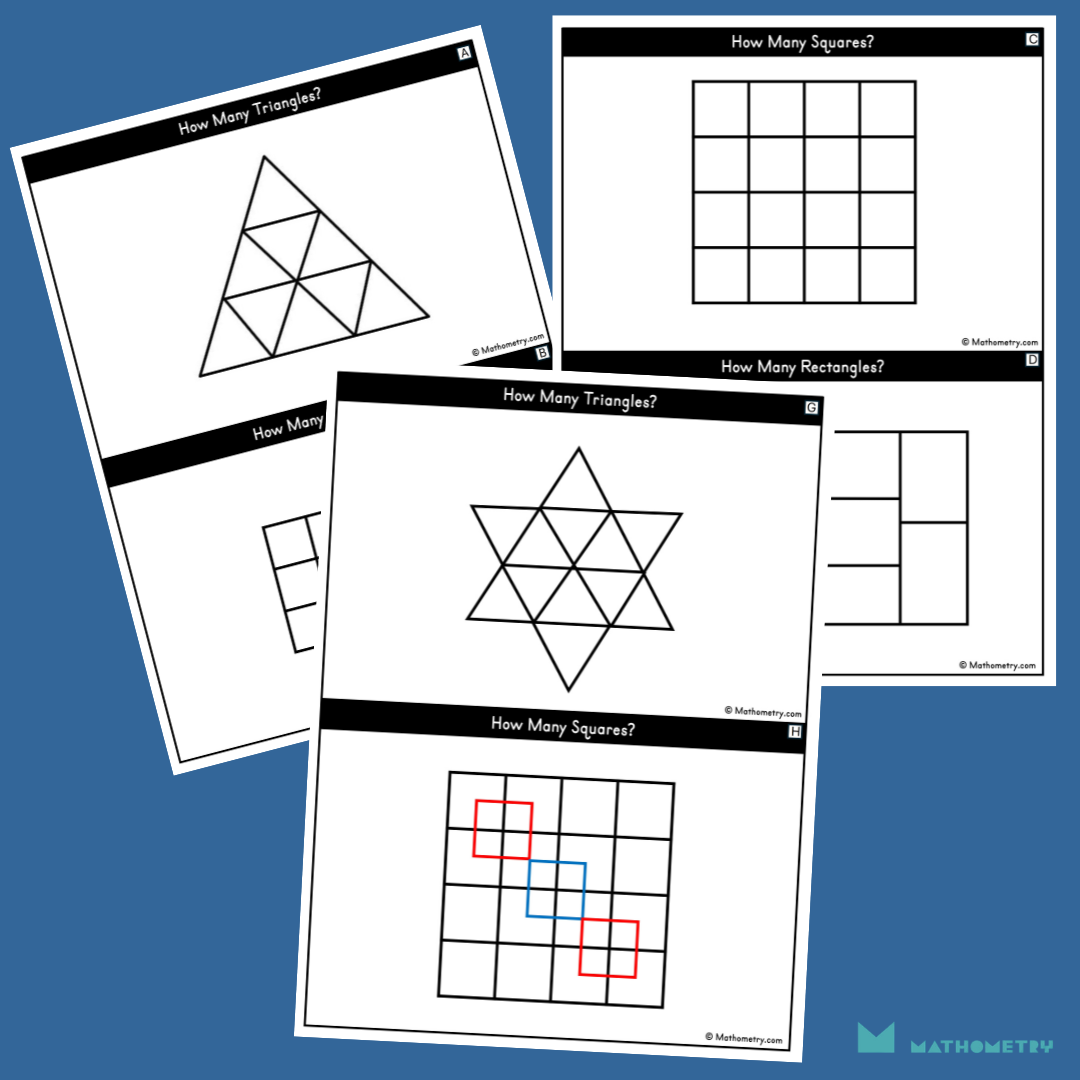
The "count the squares (or triangles)" puzzle looks like a spot-the-shape game, but underneath it's a lesson in systematic enumeration — a core habit of mind in combinatorics. In a grid, students don't just have unit squares and one giant outer square. They have every size in between, and those squares overlap and nest inside one another. A 4×4 grid, for instance, contains 16 unit squares, 9 squares of size 2×2, 4 squares of size 3×3, and 1 square of size 4×4 — 30 squares total, not the 17 many people guess on their first pass.
The reason the "obvious" answer is almost always wrong is that human perception is good at seeing shapes but bad at organizing a count of them. That gap, between seeing and systematically counting, is the entire mathematical point of the task. Students who just scan the image and point will lose track, double-count, or miss the in-between sizes. Students who develop a system (organize by size, then count each size category before moving to the next) will get a more reliable answer — and that strategy is precisely the reasoning that later generalizes into the sum-of-squares formula for an n×n grid.
Triangle versions raise the stakes further, since triangles can combine into larger triangles in less regular ways than squares do, often requiring students to consider triangles in different orientations — a nice stretch for students who complete the square version quickly.
Why It's the Ideal Low-Floor, High-Ceiling Task
This is the feature that makes the puzzle so useful, especially in those first, feeling-each-other-out days of a new class at the beginning of the school year:
- Low floor: Any student can start. You don't need to know a formula or have prior skills — you just need to be willing to look closely and start counting squares. Every student can get a foothold immediately.
- High ceiling: There's no natural stopping point. Students who count confidently can be pushed toward "how do you know you found them all?", then toward organizing the count by size, then toward predicting the count for a larger grid, and eventually toward the algebraic pattern behind the whole family of answers.
That spread means a single task can occupy a room full of students you don't know yet — some of whom haven't seen each other's math thinking in months, some of whom are brand new to the building — without anyone needing to be pulled aside for "an easier version" or "the challenge version." The task differentiates itself.
Why Use it in the First Week?
The first week of school isn't really about content delivery. It's about establishing math norms in your room: that thinking out loud is expected, that respectful disagreement is productive, that productive struggle is normal. A square-counting puzzle is tailor-made for setting that tone:
It invites disagreement. Ask partners to count independently, then compare. "I got 24." "I got 30." That gap isn't a problem to smooth over — it's the whole lesson. Students have to go back to the figure, explain their strategy, and reconcile the difference. That's exactly the kind of math discourse you want to be normal by week two, and it's low-stakes enough to practice on day one.
It's naturally collaborative. Because there's no single "trick" to unlock, partners genuinely need each other — one student spots a size-3 square the other missed, another proposes color-coding sizes to keep track. You get real collaboration, not one student explaining a known procedure to a passive partner.
It reveals thinking. In the first week, you're not just teaching — you're watching. Who dives in and starts marking up the page? Who wants to talk through a strategy before touching pencil to paper? Who gets stuck and needs a nudge versus who needs to be reined in from overcomplicating it? This task surfaces all of that in fifteen minutes.
It sets up "productive struggle" as the default. If your first math task of the year has one clean right answer arrived at one clean way, you've quietly taught students that math class is about speed and recall. If your first task is one where getting it right takes organizing your thinking rather than just knowing a fact, you've taught something important about what doing math actually feels like.
Where This Sits in the Standards
This task's strong connection to the Standards for Mathematical Practice holds true across every grade band:
- MP1 — Make sense of problems and persevere. There's no obvious entry algorithm; students have to find their own way in and persevere if their first count turns out to be wrong.
- MP7 — Look for and make use of structure. Recognizing that a 2×2 square is "made of" four 1×1 squares, and organizing a count by size, is structural reasoning in its purest form.
- MP8 — Look for and express regularity in repeated reasoning. Once students count across a few grid sizes, they start noticing the pattern (1, 5, 14, 30…) that leads toward a generalizable rule.
For elementary, content-standard alignment clusters at two strong anchor points with lighter connections elsewhere:
- Kindergarten (K.G.6) and Grade 1 (1.G.2) — composing simple shapes to form larger shapes, and composing new shapes from that composite. This is precisely what's happening when four unit squares combine into one 2×2 square.
- Grade 2 (2.G.1) — recognizing and classifying shapes by attributes, relevant if you run the rectangle version and students discuss what defines a rectangle versus a square.
- Grade 3 (3.MD.5–7, 3.G.1) — the strongest content fit in the K–5 band. Understanding area as built from counting unit squares, and area as additive, is exactly what the puzzle has students doing before you've even introduced the word "area." 3.G.1 layers in the idea that differently sized squares still share the attributes that define the category.
- Grade 4 (4.OA.5, 4.G.2) — this is where the "count for a 3×3, then a 4×4, then predict a 5×5" extension formally lives, as students generate and analyze the underlying number pattern.
- Grade 5 (5.OA.3, 5.G.3–4) — comparing total-squares to grid-size as two related numerical patterns, or pushing into whether every square is also a rectangle.
Using It in the First Week of School
A simple structure that works well for partnerships or triads:
- Silent individual count (2–3 minutes): Everyone looks at the same figure and writes down their number, without talking. This guarantees everyone has skin in the game before the group forms an answer.
- Partner or triad time (10–15 minutes): Share numbers. The group's job is to agree on one number and be ready to defend it. Providing each group with a copy of the figure inside a dry erase pocket so that they can draw on it with a dry erase marker can be helpful as students share their thinking with one another.
- Strategy share-out. Ask a few groups to describe how they counted, not just what they got. This is where "I organized by size" starts to surface as a strategy other groups adopt.
- Push the ceiling. For groups that finish quickly, prompt them to predict the count for a bigger grid, or to describe a rule for any size grid, or to try the triangle version.
This lesson requires no prerequisite skills — just a figure and a question that resists a fast answer. That combination of accessibility, depth, and the opportunities for collaborative thinking it provides, is exactly what you want modeling the tone of your math class in the first week of school.
Resources
Head to the Math Puzzles section in the All Access Math Hub to download a set of "How Many (Shape) Puzzles."
Not yet a member? Click the button below to visit our SAMPLE RESOURCES page.