
Coordinate Plane in 5th Grade: Why It Matters
The coordinate plane connects arithmetic to algebra. It lays the foundation for graphing and data analysis in later grades, and students will use it outside the math classroom too. Yet many 5th grade classrooms rush through it in order to get to topics seen as more important. When that happens, students may learn to plot a point by rote without understanding what the ordered pair actually represents.
What the Standards Actually Ask For
The coordinate plane falls under the Geometry domain in most state math standards at the 5th grade level. Generally, students are expected to:
- understand that a coordinate system is formed by two perpendicular number lines, called axes, meeting at a point called the origin, and that this structure allows any location to be described using an ordered pair of numbers (an x-coordinate and a y-coordinate).
- graph and interpret points in the first quadrant of the coordinate plane to represent and solve real-world and mathematical problems.
Notice what these standards are really asking for. They're not just asking students to plot points correctly - they're asking students to interpret what those points mean in context. That distinction matters. A student who has memorized "go over then up" and puts a dot in the right place for (3, 5) but can't tell you what that point represents in a real situation hasn't fully met the standard. A student with understanding knows that:
- each axis is a number line, and the two lines cross at zero;
- an ordered pair gives a distance along each of those lines from the origin;
- order matters, because (3, 5) and (5, 3) are different locations;
- every point on the plane matches exactly one pair of numbers.
This work also connects directly to the Standards for Mathematical Practice, especially MP2 (reason abstractly and quantitatively) and MP4 (model with mathematics). Students are translating between numbers, visuals, and real situations, which is exactly the kind of flexible thinking we want to build early.
This first-quadrant focus is intentional. It lets students build a solid foundation with positive numbers before adding complexity. In 6th grade, standards typically expand this understanding to all four quadrants, introducing negative coordinates and requiring students to plot and interpret points anywhere on the plane. This progression mirrors students' growing comfort with negative numbers, so the coordinate plane and number line work reinforce each other as they build toward more abstract algebraic thinking.
Why This Skill Matters
Here's the thing: the coordinate plane isn't an isolated math topic. It's a language system that shows up repeatedly outside of the math classroom once students know how to read it.
- GPS and map navigation - Latitude and longitude coordinates pinpoint exact locations on Earth, the same way (x, y) pairs pinpoint locations on a grid. When a student understands that a location can be described with two numbers relative to a fixed point, they're building the same mental model that powers real-world navigation.
- Stadium/theater seating - Sections, rows, and seat numbers function as a coordinate system to help people find their exact seat.
- Video games - Character movement, map layouts, and collision detection in games are built on coordinate systems tracking positions in real time.
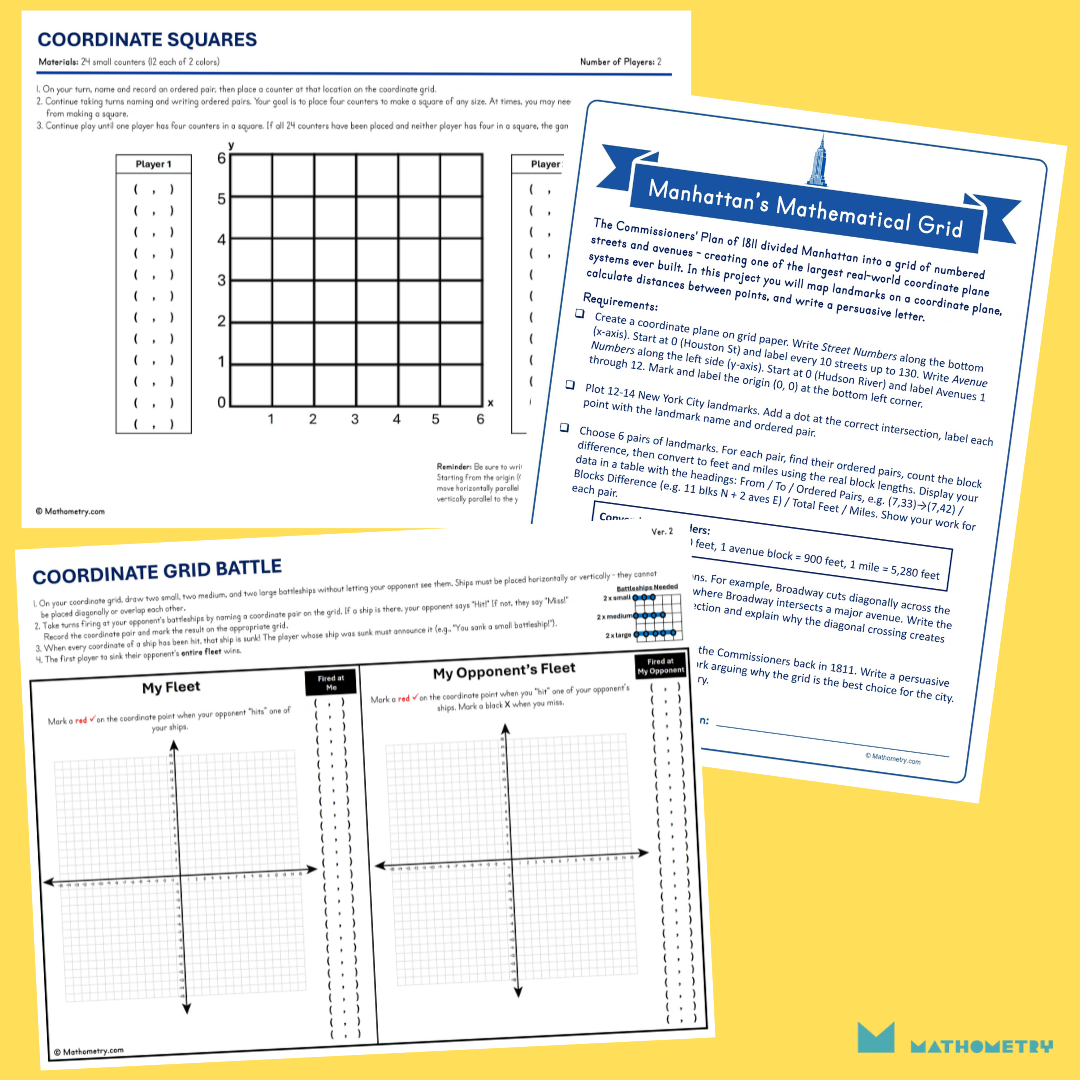
- City planning and street grids - Many places (like Manhattan) are laid out on a grid system, where you can locate an address using two coordinates (street and avenue).
- Battleship and grid-based games - Classic games rely entirely on coordinate guessing and logic to locate a hidden target.
- Architecture and construction blueprints - Architects use coordinate systems to mark exact measurements and placements when designing buildings. A student building confidence with (x, y) pairs today is building the foundation for spatial reasoning they'll use in design fields later.
- Air traffic control - Pilots and controllers track aircraft locations and flight paths using coordinate-based positioning systems.
- Weather and radar maps - Meteorologists plot storm systems and weather patterns using coordinate grids to track movement and predict paths.
- Spreadsheets - Every cell in an Excel or Google Sheet is identified by a column and row (like A1 or C4) - a direct real-world parallel to ordered pairs.
- Data graphs and charts - Line graphs, scatter plots, and bar graphs (common in science, sports stats, and business reports) all rely on plotting points using coordinate pairs to show trends and relationships. In middle and high school, students will graph functions, analyze scatter plots, and interpret trend lines. All of that depends on comfort with the coordinate plane.
Making It Concrete for Students
Abstract instruction ("plot the point (4, 2)") tends to produce students who can follow directions but can't explain why. To make the concept stick we need to:
- Anchor it in a real context first. Before introducing formal notation, have students describe locations using two pieces of information - like seats in an auditorium or squares on a game board - so they discover the need for an ordered system before you name it for them.
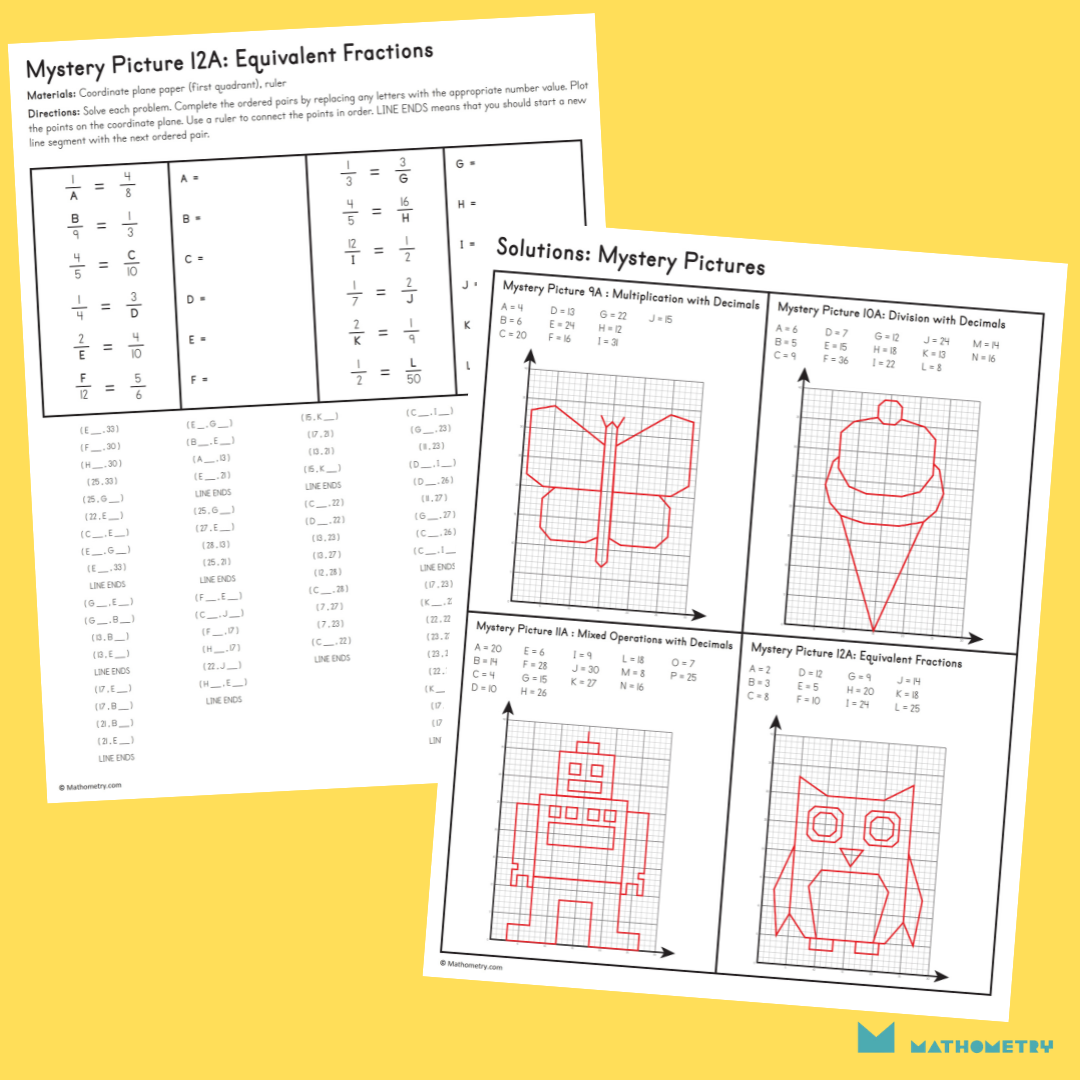
- Use games. Coordinate grid games (battleship-style challenges or mystery picture reveals) give students low-stakes practice while keeping engagement high. Repetition matters - fluency with x before y and origin-as-starting-point takes multiple reps.
- Ask "what does this point mean?" This is the piece that's easy to skip but directly addresses the interpretation language in most standards. If students can plot without narrating meaning, push them to explain it in their own words.
The Bottom Line
The coordinate plane is an elementary math topic that's genuinely connected to real life and foundational for what comes next. When students leave 5th grade with real fluency - not just point-plotting mechanics, but an understanding of why coordinates work the way they do - they're walking into middle school ready for functions, graphing, and spatial reasoning with real confidence.
It's worth spending the time on games and hands-on activities. It's worth slowing down to ask "what does this point actually mean?" That's where the real understanding lives.
RESOURCES
Head to the 5th Grade Geometry section in the All Access Math Hub for hands-on coordinate plane tasks and centers. You'll also find Math Projects to build understanding of the coordinate plane in the Grades 3-5 Math Projects section.
Not yet a member? Click the button below to download SAMPLE RESOURCES from the Hub.