
A 15-Minute Number Talks Routine for K–5 Classrooms
Over the past 15 years, our consultants have implemented various structures for Number Talks in a diverse range of elementary schools. While each approach offers benefits, one structure consistently stands out for maximizing student participation, strengthening mathematical discourse, and accelerating flexible mental reasoning strategies.
When implemented consistently from Kindergarten through 5th grade, this 15–20 minute Number Talk routine drives measurable growth in mental computational fluency.
This high-impact Number Talk routine includes:
- A brief fluency warm-up
- Four carefully sequenced problems:
- Problems 1–2: Students choose and share their own mental reasoning strategies
- Problems 3–4: Students apply a focus strategy
Number Talks Routine (15–20 minutes)
Classroom Setup: Students sit in a circle with a dry erase board and marker placed on the floor in front of them.
a) Fluency Warm-Up (1–2 minutes)
The teacher reveals 4–5 images or expressions one at a time. After a short think time, students respond to the given prompt chorally in unison.
- Problems are intentionally selected to activate prior knowledge and prime students for the focus strategy.
- Example: If the focus strategy is Near Doubles, 4–5 images of doubles facts are used.
b) Problem 1 (approx. 4 mins.)
- The teacher writes the problem horizontally
- Students solve mentally using any strategy
- Students signal when ready (e.g. thumbs up)
The teacher:
- Collects and records answers
- Invites a student to begin the discussion
- Listens carefully to student explanations and records thinking
Students:
- Share and explain their strategy
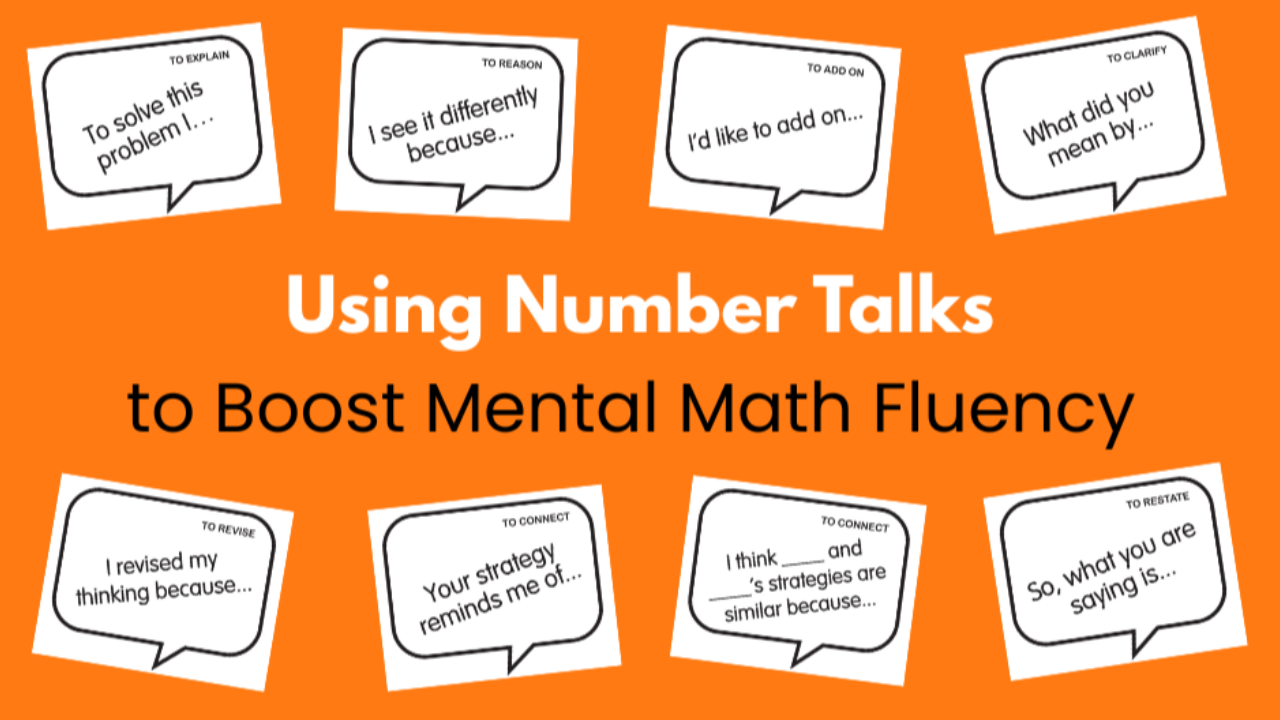
- Lead the conversation by adding on to a peer's thinking or asking a question:
- "I'd like to add on ..."
- "What strategy did you use?"
- "Which answer would you like to defend or eliminate?"
- "What did you mean by ...?"
Focus: Student-led discourse and strategy diversity.
c) Problem 2 (approx. 4 mins.)
- Same structure as Problem 1
- 3–4 students share strategies
At this point:
- If a student uses the focus strategy, the teacher highlights it
- If not, the teacher models the strategy explicitly after students have shared their strategies:
- "Another strategy we can use is…"
Focus: Surface or introduce the focus strategy.
d) Problem 3 (approx. 5 mins.)
- The teacher writes problem 3 horizontally
- Students solve mentally using the focus strategy and write their answer only on individual dry erase boards
- Teacher scans and records responses in a list
Students then:
- Turn and Talk to explain how they used the focus strategy
- 2–3 students share thinking with the class
Peer-to-peer prompts may include:
- "How did you use ___ (focus strategy) to solve this problem?"
- "Did you use ___ (focus strategy) in the same or a different way?"
- "Do you agree or disagree, and why?"
Focus: Strategy application and verbal reasoning.
e) Problem 4 (approx. 5 mins.)
- The teacher writes problem 4 horizontally
- Students again use the focus strategy to solve mentally. After a brief think time students show all steps in their thinking on their individual dry erase board.
The teacher:
- selects examples of student work where the same strategy has been used in different ways, or different representations of the same strategy have been used
- facilitates student discussion using selected student boards and a document camera
Focus: Deepening conceptual understanding and comparing approaches.
Key Practices for Successful Number Talks Implementation
Schools that see the greatest gains in mental reasoning fluency consistently implement the following:
1. Protected Time for Number Talks
Multiple times per week are scheduled for Number Talks across all grade levels.
2. Strategic Scope and Sequence
A K–5 progression of key mental math strategies has been developed to ensure coherence and build on prior knowledge.
3. Collaborative Teacher Planning
Teacher teams meet regularly to:
- anticipate student strategies
- unpack key mathematical concepts
- analyze student thinking from previous sessions
Why This Number Talks Structure Works
This approach is effective because it:
- promotes high student engagement
- builds flexible, efficient computation strategies
- centers student voice and mathematical discourse
- bridges conceptual understanding and procedural fluency
Ready to Implement Number Talks in Your School?
If you're looking to strengthen mental math fluency and student-centered math discussions in your classrooms, we can help. Contact us today to learn how to successfully implement Number Talks across your school.