
Getting Started with K–2 Math Fluency Centers
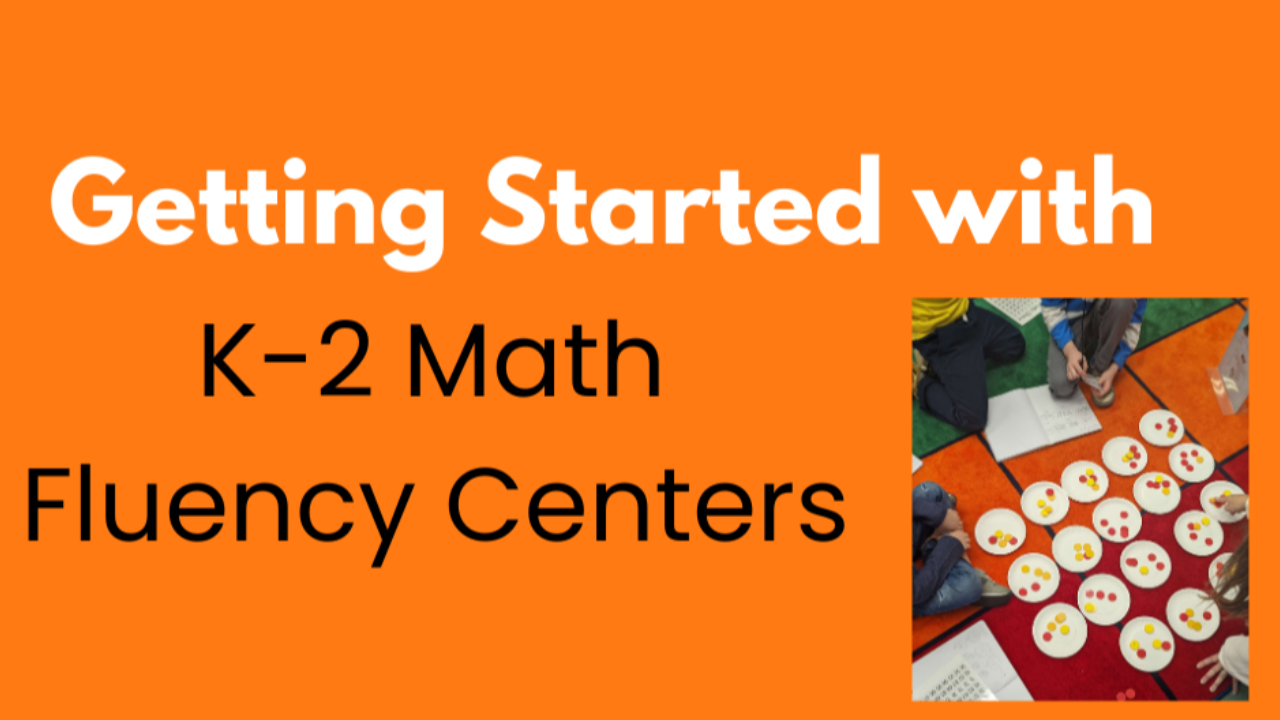
Many of our partner schools use the Early Childhood Assessment in Mathematics (ECAM), developed by the Board of Education of the City of New York for students in Kindergarten through 2nd grade. This assessment is conducted as a one-on-one interview and serves as a comprehensive tool for assessing early mathematical understanding in three strands: Counting, Numeration, and Addition and Subtraction. Students are assessed three times per year (September, January, May). In the periods between each assessment cycle teachers confer regularly with each student and measure progress within each learning progression using checklists and anecdotal notes. The centers in our K–2 Fluency Hub were developed to support teachers in effectively using fluency data to differentiate instruction by providing students with regular opportunities to work at their 'just-right' level while building number sense, and by enabling teachers to monitor student growth over time.
How Do Math Fluency Centers Work?
After completing the assessment interview, the teacher analyzes the results to identify each student's learning stage for each strand. Students are then paired with a partner at a similar stage within the selected focus strand, and a center activity is selected to support their learning. Many schools have set periods of time where all K–2 students work on the same strand, e.g. Sep–Dec: Counting; Jan–March: Numeration; April–June: Addition & Subtraction, to ensure that students have opportunities to build skills in all three assessed strands during the year and provide a clear focus of discussion for grade level teacher meetings focused on data and looking at student work.
Students work in pairs at math fluency centers for 20 minutes, 2–3 days a week, often repeating the same activity for 4–6 sessions. Repeating the task is a key factor in the centers' effectiveness. During the first session, students typically focus on understanding the rules, materials, and process of the activity. Repeated practice allows them to dive deeper into the math skills and concepts. While working in the centers, students are expected to explain their strategies to their partner and document their thinking in a Fluency Centers notebook. This notebook serves as a record of each child's progress throughout the year.
As students engage in math fluency centers, the teacher observes and confers with selected students, paying close attention to progress on the "Next Steps" for each student's current stage. Conferring with students in this way provides an opportunity for the teacher to hear individual students' thinking and nudge student thinking forward. If a student demonstrates mastery of a focus skill, a new fluency center is introduced to target another skill within the same stage. Once the student has mastered all skills in the current stage, a new center aligned with the next stage is introduced, allowing for further progress along the continuum.
When is the Best Time to do Fluency Centers?
To ensure that fluency centers are effective, it is important to dedicate a consistent 20-minute block of time, 2–3 times per week. This block could be scheduled for the start of the day as students arrive, at the beginning of math workshop, or immediately after lunch. Keeping the schedule consistent helps make fluency centers a regular part of the classroom routine, reducing the chances of skipping them when the schedule gets busy.
How Should I Introduce Fluency Centers?
When introducing fluency centers for the first time, start gradually. On the first day or two, consider assigning the entire class the same center. This allows you to focus on establishing expectations for sharing materials, taking turns, and cleaning up. Model how to play new games and role-play potential challenges, demonstrating how students can solve these issues independently without teacher assistance.
After a few days, introduce a second center and run two centers simultaneously for a day or two. Gradually increase the number of centers until every student is working at a center appropriate to their stage on the continuum.
The first few weeks of fluency centers can be the most challenging. However, by preparing materials in advance and clearly communicating expectations, you will soon notice significant improvements in students' number sense and ability to work collaboratively with a partner.
How Can I Organize Fluency Centers to Run Smoothly?
Since fluency centers are limited to 20 minutes per session (3 minutes for setup, 15 minutes for partner work, and 2 minutes for cleanup), having efficient structures in place is essential to maximize this time. Many teachers find it helpful to display a digital timer on an interactive whiteboard. This allows students to track the time independently and begin packing up at the 18-minute mark without teacher prompting.
Organizing materials for each center in heavy-duty plastic bags or plastic envelopes helps streamline both the start and end of sessions. Materials can be stored in baskets for easy student access. Assigning one student per partnership to handle the collection and return of materials can further enhance efficiency.
To extend the life of fluency centers, consider printing activities on cardstock and laminating them, or print on paper and place in a plastic sleeve. This allows the reuse of materials year after year. Reusable dry-erase pockets are another great option for centers with recording sheets. Simply insert the sheet into the pocket for students to use with dry-erase markers. At the end of the session, the pockets can be wiped clean and used again, eliminating the need for regular photocopying of recording sheets.
Need support in getting started with Fluency Centers in your school or district? Contact Us for more information.