Two Hands-On Tasks for Building Equivalent Fractions
Equivalent fractions are one of the most important ideas students encounter in elementary mathematics — but they are often taught as a rule to memorize rather than a concept to understand. Students may learn that they can multiply or divide the numerator and denominator by the same number, yet many still struggle to explain why the fractions are equal or what the fractions actually represent. Without a strong conceptual foundation, equivalent fractions become a procedural task rather than a meaningful mathematical relationship.
Developing a deep understanding of equivalent fractions helps students see fractions as numbers that can be renamed in different ways while representing the same quantity. This understanding is essential for later work with comparing fractions, adding and subtracting fractions, and working with ratios, decimals, and percentages. When students truly understand equivalence, they are able to reason flexibly about fractions instead of relying on memorized steps.
Manipulatives play a critical role in building this understanding. By using concrete models — such as unlabeled fraction kits, fraction strips, or geoboards — students can physically see how the same whole can be partitioned in different ways while still representing the same amount. These hands-on experiences allow students to connect visual models, language, and symbols, helping them construct meaning rather than simply follow a procedure.
Below are two tasks using concrete materials we've used to support students in developing a deeper, more meaningful understanding of this foundational concept. In the first part of the lesson, students work in partnerships to build equivalent fractions and look for patterns and relationships. During this time the teacher confers with students and asks questions that invite students to articulate in their own words the patterns and connections they are noticing. As students begin to finish the activity, the teacher selects and sequences student work that will allow them to connect the experience to the formal learning during the whole-class discussion.
1. Equivalent Fractions Exploration
Materials: fraction kits (rectangular or circular)
- Give the largest piece in your fraction kit the value of one whole. Name the other size pieces in your kit in relation to the whole.
- How many ways can you make one-half using pieces in your fraction kit of the same size and shape? Draw and label the equivalent fractions you find.
- Order your data. Describe any patterns that you notice.
- How many ways can you make one-third using pieces in your fraction kit of the same size and shape? What about one-fourth? Record your findings and describe any patterns that you notice.
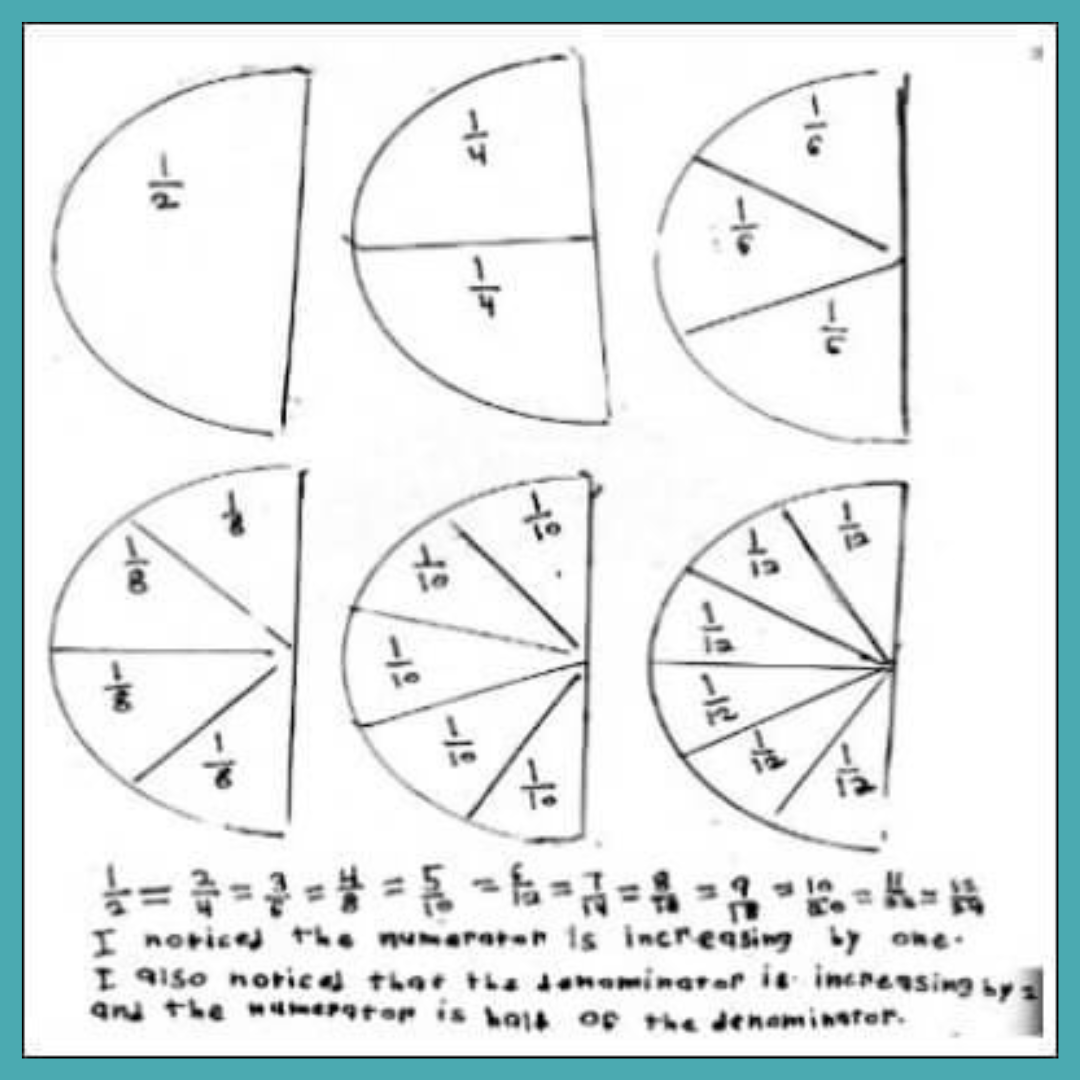
Using the fraction pieces, this 3rd grade student discovered that one-half is equivalent to two-fourths, three-sixths, four-eighths, five-tenths, and six-twelfths. She was able to continue this sequence mentally using the pattern she noticed. "I notice the numerator is increasing by one. I also noticed that the denominator is increasing by 2 and the numerator is half of the denominator." During the whole-class discussion the teacher asked questions to help students formalize their understanding of the relationship between the numerator and denominator for each unit fraction explored. Students also made conjectures about equivalent fractions for unit fractions they had not yet explored with the fraction kits (e.g. one-fifth).
2. Equivalent Fractions on a Geoboard
Materials: geoboards, rubber bands, geoboard recording paper
- Make the largest square possible on a geoboard. Partition the square to show two equal regions.
- Partition one region to show a fraction that is equivalent to one-half.
- Record your work on geoboard paper. Write the fraction each part of the square represents.
- Show at least four different ways you can partition one region to show an equivalent fraction for one-half. Record your work.
- Order your solutions. Describe any patterns that you notice.
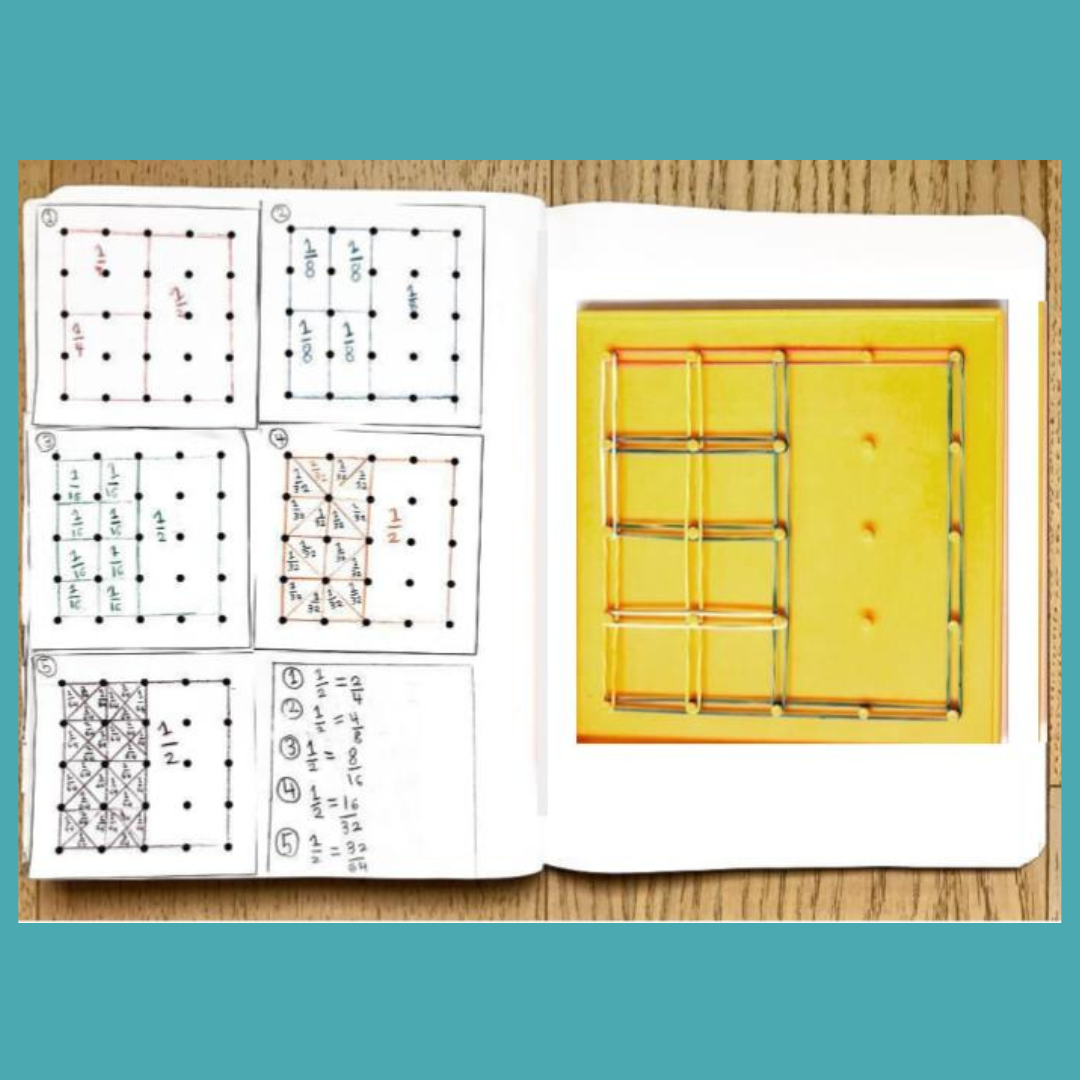
This third grader found five different ways to partition one region to show equivalent fractions for one-half, including 32 sixty-fourths!
Resources
Looking for more hands-on activities to build conceptual understanding of fractions? Head to the All Access Math Hub and check out the fraction concepts in the Number section for each grade level.
Not yet a member? Click the button below to download a variety of SAMPLE RESOURCES from the Hub.